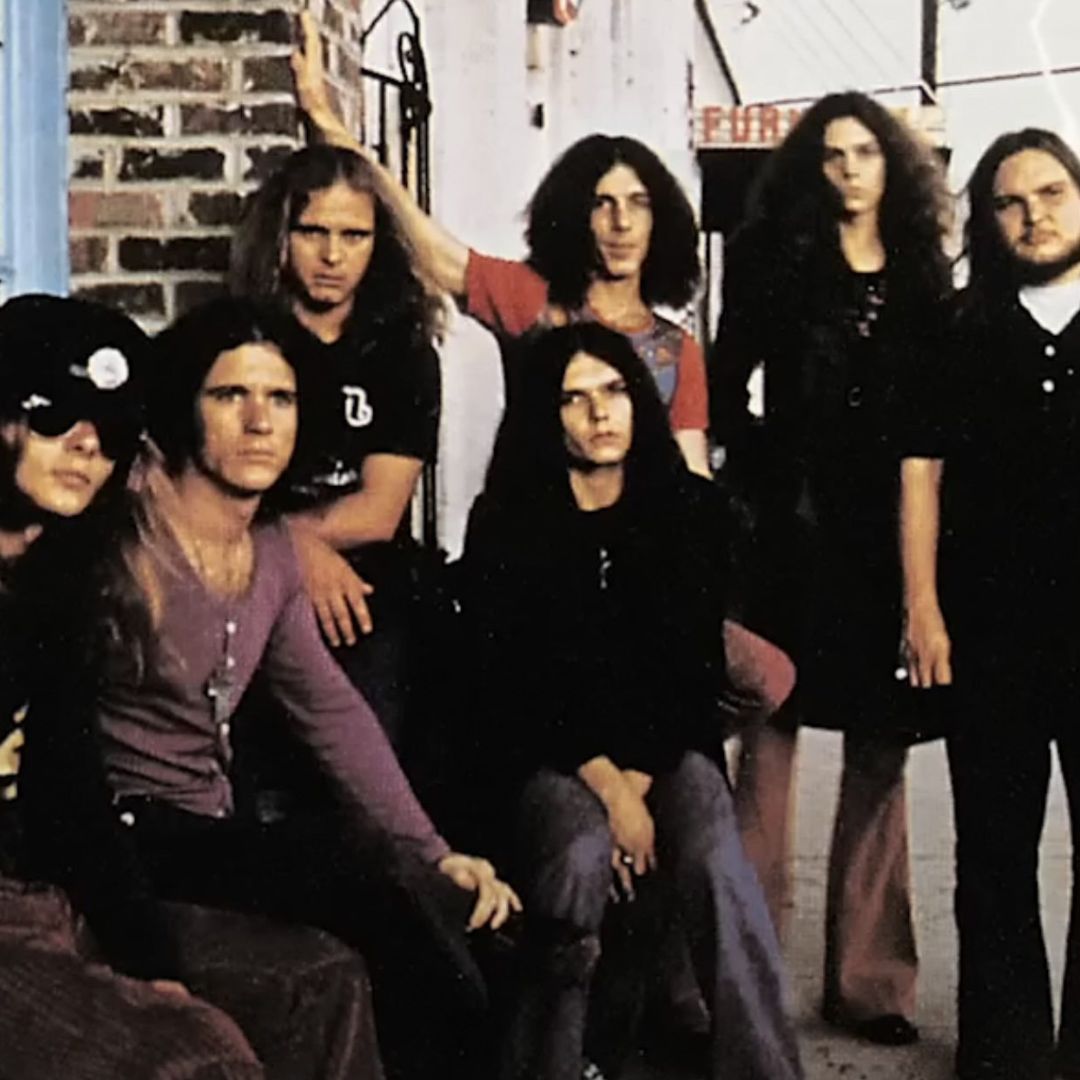
In October 1977, Lynyrd Skynyrd released what was supposed to be the album that made them bigger than ever. Its cover showed the band standing on a city street while the buildings around them burned. Three days later, the band’s chartered plane crashed in the woods of Mississippi. Almost overnight, that fiery cover went from bold to unbearable.
A Band on Fire
The original cover of Street Survivors was a photograph by David Alexander. It showed the members of Lynyrd Skynyrd standing together on a street, every building behind them engulfed in flames. It was meant to capture the heat of a Southern rock band at the top of its game.
Look closely at the original, and one detail is hard to forget. Near the center of the picture, the flames rise so high that they nearly hide the face of guitarist Steve Gaines.
Over the years, a rumor grew that only the members who died in the crash were touched by the flames on the cover. That part is not true. The fire reaches almost everyone in the photo. But the image of Steve Gaines, his face nearly lost in the blaze, is the detail that fans still talk about today.
October 17, 1977
Street Survivors was released on October 17, 1977. It was the band’s fifth studio album, and it was a showcase for Steve Gaines, a gifted guitarist, singer and songwriter who had joined the band just a year earlier on the recommendation of his older sister, Cassie, one of the band’s backup singers.
Gaines wrote “I Know a Little” and co-wrote “You Got That Right” with Ronnie Van Zant. The album also included “What’s Your Name” and “That Smell,” which Van Zant wrote as a warning to his hard-living bandmates about where drugs and drinking could lead. The band had even scrapped its first set of recordings and started over with producer Tom Dowd to get the album right.
To promote it, Lynyrd Skynyrd set out on a new tour. They called it the Tour of the Survivors.
October 20, 1977
The band was only five shows into that tour. On October 20, after playing the Greenville Memorial Auditorium in South Carolina, they boarded a chartered Convair CV-240 bound for Baton Rouge, Louisiana, where they were scheduled to play at LSU the next night. The plane was close to 30 years old, and several members had already said they wanted to get rid of it.
Cassie Gaines was so uneasy about the plane that she had been riding in the band’s cramped equipment truck instead. On that day, Ronnie Van Zant convinced her to fly with everyone else.
Near the end of the flight, the plane ran low on fuel. The pilots tried to reach a small airfield in McComb, Mississippi, but they did not make it. At about 6:52 p.m., the plane skimmed the treetops and crashed into a wooded swamp near Gillsburg, Mississippi. Because the tanks were empty, there was no fire and no smoke to guide rescuers to the wreck.
Ronnie Van Zant, Steve Gaines, Cassie Gaines, assistant road manager Dean Kilpatrick, pilot Walter McCreary and co-pilot William Gray were killed. Twenty people survived, many with terrible injuries. Federal investigators later blamed the crash on the plane running out of fuel because the crew failed to keep track of it, with poor flight planning and a troubled engine also playing a role.
A Widow’s Request
After the crash, the cover of Street Survivors was suddenly painful to see. A band surrounded by fire, on an album named for survivors, released days before half its spirit was lost.
Teresa Gaines, Steve’s widow, asked MCA Records to change it. Out of respect for those who died, the label pulled the original artwork. In its place, MCA used a similar photograph of the band standing in front of a plain black background, an image that had originally appeared on the back of the album.
Street Survivors went on to become the band’s second platinum album and reached No. 5 on the U.S. album chart, the highest of their career. It remains the only studio album Steve Gaines ever made with Lynyrd Skynyrd.
Thirty Years Later
The flame cover disappeared from stores for three decades. Original copies with the burning street became prized by collectors. Then, in 2008, a Deluxe Edition of Street Survivors restored the original artwork, along with the band’s first recordings of many of the songs.
Today the cover reads less like a warning and more like a snapshot of a band at its brightest, frozen just days before everything changed.
Do you remember which version of the Street Survivors cover you first saw?