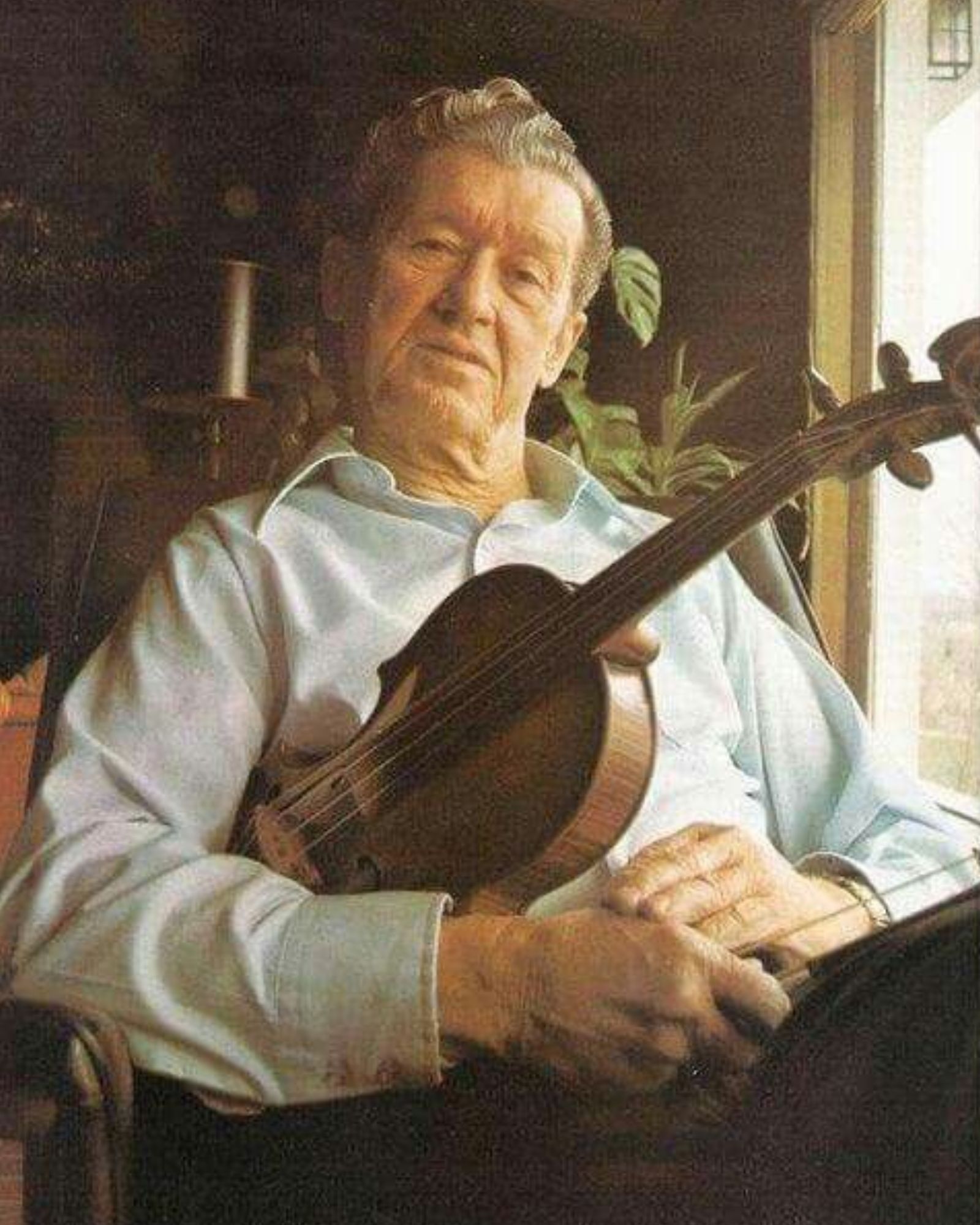
When a legend dies, people expect a grand farewell: crowds, cameras, a long procession of famous friends. Roy Acuff, the man they called the King of Country Music, went the other way. He was laid to rest just hours after his death, quietly, in a cemetery plot he had bought more than thirty years before.
A baseball dream that turned into music
Roy Claxton Acuff was born on September 15, 1903, in Maynardville, Tennessee, the son of a Baptist preacher who played the fiddle. Roy’s first dream was baseball. In 1929 he tried out for the Knoxville Smokies, a minor league team, but a series of collapses after a severe sunstroke ended that dream.
Stuck indoors while he recovered, he picked up his father’s fiddle. Soon he was singing and playing in a traveling medicine show in the mountains, where there were no microphones and he learned to sing loud enough to be heard over any crowd.
The King of Country Music
In 1938, Roy and his band, soon renamed the Smoky Mountain Boys, joined the Grand Ole Opry. Songs like “The Great Speckled Bird” and “Wabash Cannonball” made him one of the biggest stars in America. Hank Williams once called him the biggest singer country music had ever known.
Roy’s influence went far beyond his own records. In 1942, he and songwriter Fred Rose founded Acuff-Rose, the first major country music publishing company in Nashville. It went on to sign Hank Williams, Roy Orbison and the Everly Brothers. In 1962, Roy became the first living artist ever elected to the Country Music Hall of Fame.
He stayed with the Opry for 54 years. Fans loved his showmanship: twirling his cane, walking the dog with his yo-yo, balancing a fiddle bow on the end of his nose. When the new Grand Ole Opry House opened in 1974, he even tried to teach President Richard Nixon a few yo-yo tricks. After a long night on stage, he would often spend hours signing autographs.
Planning for the end
For all his fame, Roy Acuff thought ahead about how his life would end. In 1959, he bought a 12-grave burial plot at Spring Hill Cemetery in Nashville. Over the years, a massive marker was placed there: a slab of Georgian marble measuring 8 feet by 16 feet and weighing 13,500 pounds. Sculpted into it are a fiddle, a bow and a scroll of music. It is the first marker visitors see when they drive into the cemetery.
After his beloved wife, Mildred, passed away, Roy moved into a house built on the grounds of Opryland, just steps from the Grand Ole Opry House, so he could stay close to the show he loved.
November 23, 1992
Roy’s health had been failing. One of his last public appearances came in September 1992, when he was helped onto a Nashville stage for a campaign rally for President George H. W. Bush.
Early on November 23, 1992, Roy Acuff died of congestive heart failure at Baptist Hospital in Nashville. He was 89. Just hours later, he was buried at Spring Hill Cemetery. According to the Associated Press, Opry officials said the quick burial was done at the family’s request, and a memorial service was planned for later in Nashville.
President Bush issued a statement mourning his friend. He recalled visiting the Opry to hear Roy sing and said what he cherished most was Roy’s kindness and modesty. He also shared a line Roy had once said about himself:
“I want to go down as a gentleman in country music.”
Porter Wagoner put it more simply. He told the Los Angeles Times that Roy would be missed more than perhaps any entertainer in the history of the business:
“I don’t think anyone will ever replace Roy Acuff.”
Legends who saw it coming
Roy Acuff was not the only country legend who seemed to know how he wanted his story to end. Decades later, Merle Haggard told his family a week before his death that he would pass away on his birthday. On April 6, 2016, the day he turned 79, he did. Like Roy, Merle was laid to rest in a private service, at his ranch in California.
There is something fitting about it. Men who spent their lives in front of crowds chose to make their final goodbye a quiet one, close to the people who knew them best.
A fiddle in marble
Today, Roy Acuff rests at Spring Hill among other country greats; Earl Scruggs is buried just across from him. The giant marble marker with its carved fiddle still greets everyone who enters the cemetery.
It does not list his hits or his awards. It simply shows the instrument he picked up as a young man recovering from sunstroke, the one that carried him from a medicine show to the very top of country music.