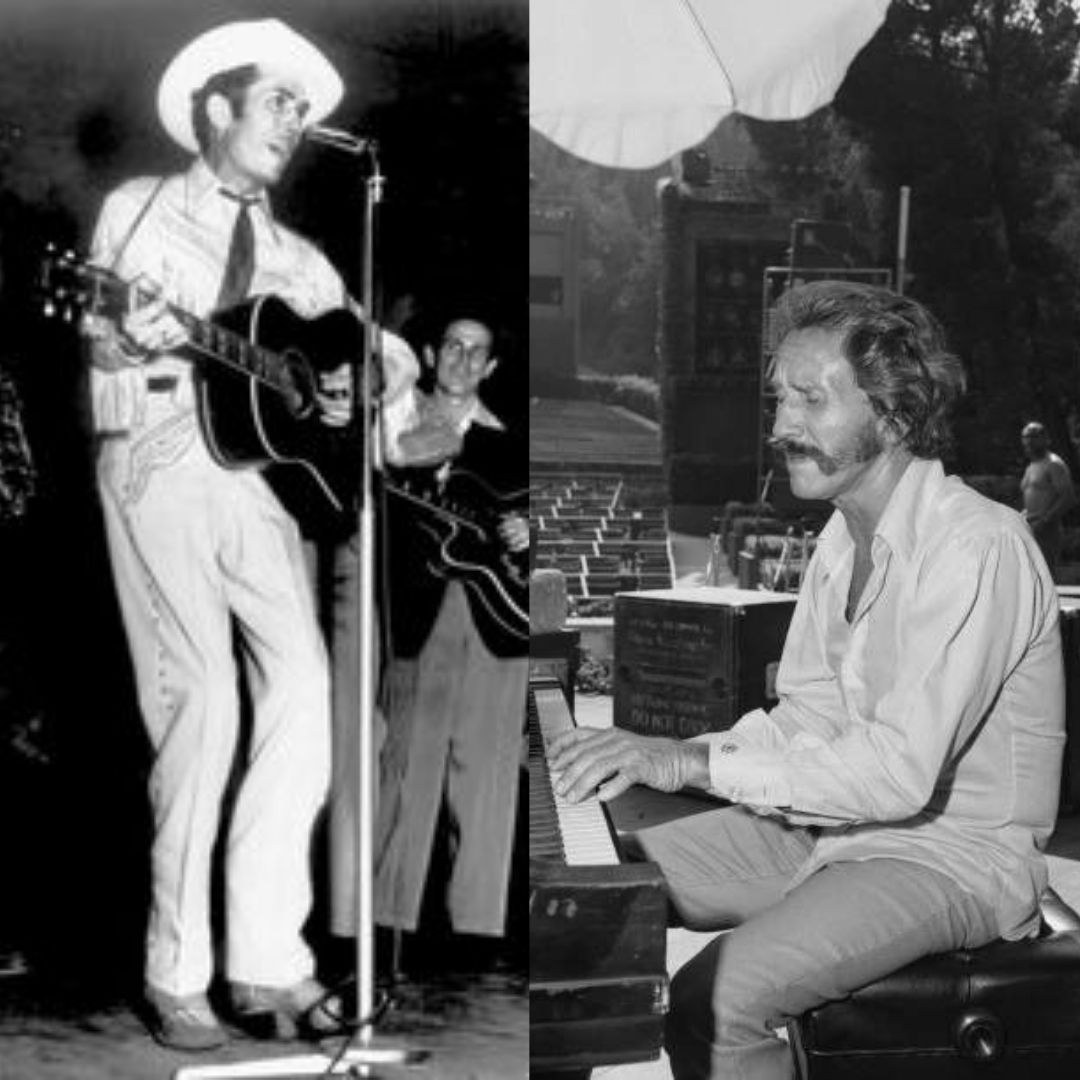
Some songs carry more than a melody. “Take These Chains from My Heart” carries the last chapter of Hank Williams’ life, and years later it found a home in the voice of another country legend, Marty Robbins.
Hank’s final session
On September 23, 1952, Hank Williams went into Castle Studio in Nashville with producer Fred Rose. Nobody knew it then, but it would be the last recording session of his life. That day he cut four songs, including “Your Cheatin’ Heart,” “Kaw-Liga” and “Take These Chains from My Heart.”
Unlike most of Hank’s hits, he did not write this one. It came from Fred Rose and songwriter Hy Heath. Hank’s biographer Colin Escott called it perhaps the best song Rose ever brought to Hank, because it sounded so much like something Hank could have written himself. The song is a plea from a man to the woman who left him. If she no longer loves him, he asks, she should at least set his heart free.
The band that day included Tommy Jackson on fiddle, Don Helms on steel guitar, Jack Shook on rhythm guitar, Floyd “Lightnin'” Chance on bass, and a young Chet Atkins on lead guitar.
A No. 1 he never saw
Hank Williams died on New Year’s Day 1953, at just 29 years old. In the months that followed, his final recordings were released one after another. “Take These Chains from My Heart” came out in April 1953 and climbed to No. 1, his final chart-topping hit for MGM Records.
Like “Your Cheatin’ Heart,” it seemed to sum up the heartbreak that ran through Hank’s life and music. For many fans, it became one of the songs that defined his legend.
The young man from the Arizona desert
That same year, 1953, Marty Robbins moved to Nashville and joined the Grand Ole Opry. His road there had been anything but easy.
Martin David Robinson was born on September 26, 1925, in a shack in the desert outside Glendale, Arizona. His parents divorced when he was 12. As a boy he loved cowboy movies and Gene Autry, and he dreamed of being a singing cowboy himself. He enlisted in the Navy in 1943 and taught himself guitar while in the service.
Back in Phoenix after the war, he played local clubs, landed a radio show and then a TV show. When Opry star Little Jimmy Dickens came through town, he heard Marty and recommended him to Columbia Records.
Mr. Teardrop
Marty Robbins turned out to be one of the most versatile singers country music ever had. He sang western ballads, pop, rockabilly, Hawaiian songs and gospel. He wrote most of his own material, including the Grammy-winning “El Paso” and “My Woman, My Woman, My Wife.” Over thirty years he placed 94 songs on Billboard’s country singles chart.
But what fans remembered most was the emotion in his voice. He earned the nickname “Mr. Teardrop” for the way he could make a sad song feel personal. Johnny Cash once said there was no greater country singer than Marty Robbins.
That is why Hank’s song suited him so well. Marty did not need to dress it up or make it his own with fancy changes. He simply sang it straight, with that warm, aching tenor, and let the story do the work.
Two legends gone too soon
Marty Robbins fought heart disease for much of his later life. He survived a major heart attack in the late 1960s and went through bypass surgery in 1970, then kept recording, touring and even racing stock cars in NASCAR. He was elected to the Country Music Hall of Fame in October 1982. Two months later, on December 8, 1982, he died after another heart attack. He was 57.
Hank Williams and Marty Robbins never got the long lives their talent deserved. But every time Marty’s voice carries Hank’s last No. 1, the two of them are in the same room again, one song apart and one heartbreak together.