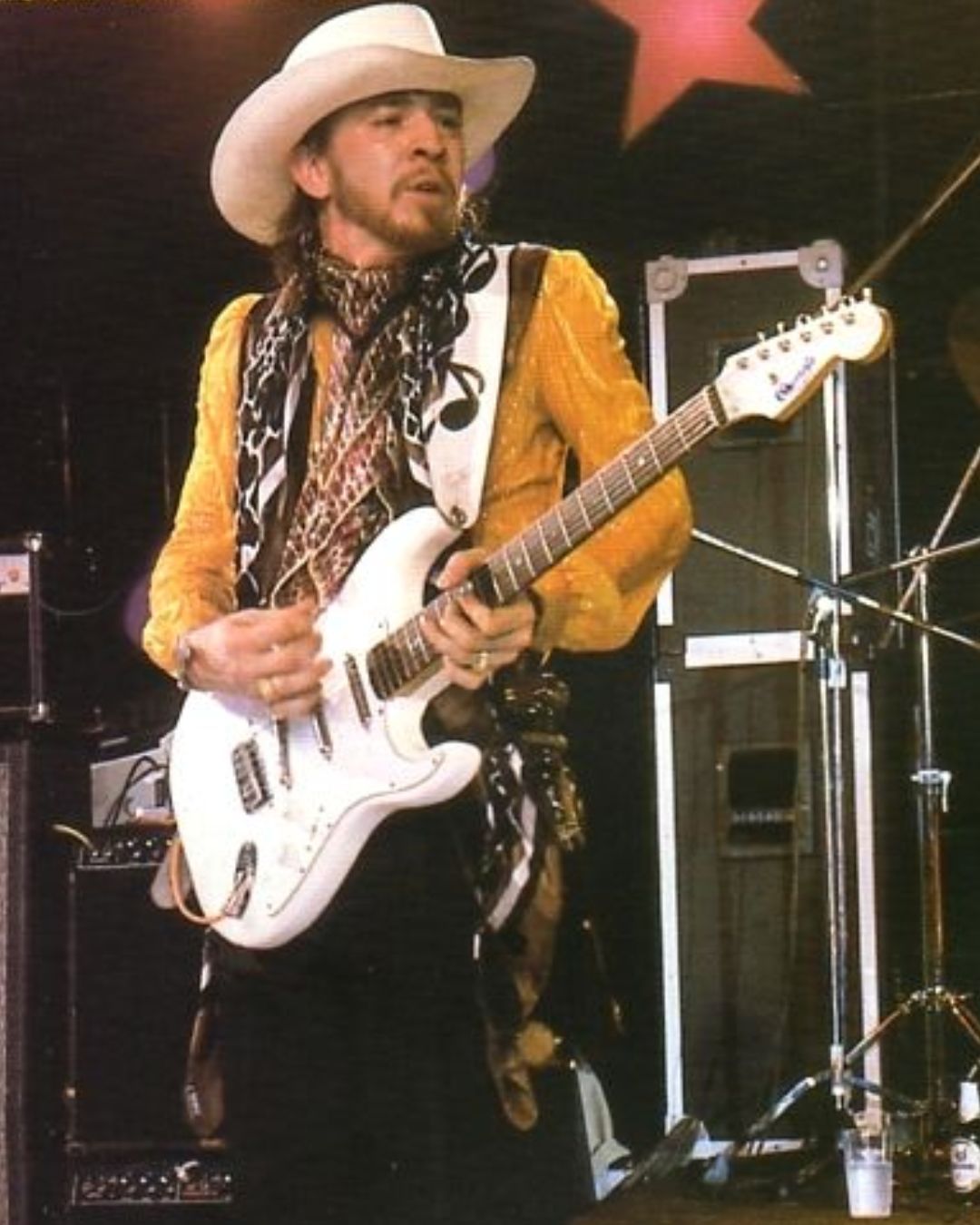
When Stevie Ray Vaughan and Double Trouble went into Dallas Sound Lab in March 1985 to make Soul to Soul, one man was missing. Charley Wirz, the Dallas guitar maker who had looked after Stevie’s instruments for years, had died suddenly a few weeks earlier. Stevie wrote a song for him, “Life Without You,” and through those sessions he leaned mostly on one instrument: the white guitar Charley had built for him by hand.
The Man Behind Charley’s Guitar Shop
Charley Wirz was a former schoolteacher and bartender who opened Charley’s Guitar Shop in Dallas in 1976. People who worked there later described it as a place he wanted traveling musicians to treat as a home away from home. He also started a show just for vintage guitars, an event that outlived him and grew into the Dallas International Guitar Festival.
For Stevie Ray Vaughan, Charley was the man who serviced his guitars and remained a close friend for years. Charley found him a 1961 Stratocaster, and he worked on Stevie’s battered ’59 Strat so often that Stevie later said it felt as if it had come from Charley too.
A White Guitar Built From Parts
Sometime around late 1983, Charley assembled a white, Stratocaster-style guitar for Stevie from spare parts. It had a fixed bridge, three lipstick-tube pickups, and a metal neck plate engraved with three words: “More in ’84.” Accounts differ slightly on the full wording. Some sources give it as “To Stevie Ray Vaughan, more in ’84,” while a 1985 Guitar World profile quoted it as “To Stevie From Charley. More In ’84.”
Charley built a similar guitar for Stevie’s brother, Jimmie Vaughan. Mark Pollock, a close friend of Charley’s who watched the guitars come together, remembered him being “like a proud father” during the build.
Stevie named the white guitar “Charley.” According to that same 1985 Guitar World profile, it is the guitar he holds on the cover of Couldn’t Stand the Weather, and the magazine described its sound as thin, edgy and cutting, sweet but hard.
February 1985
The two friends were not finished. Before Charley died, they had been talking about building Stevie a custom-scale neck.
On February 3, 1985, Charley Wirz died suddenly in Orange County, California. He was 40 years old. One account says he was attending the NAMM music trade show in Anaheim at the time. He was buried in Dallas.
Making Soul to Soul Without Him
The Soul to Soul sessions ran from March to May 1985 and were not easy ones. The band brought in keyboardist Reese Wynans, saxophonist Joe Sublett and songwriter Doyle Bramhall to help get the record finished.
In the studio, Stevie Ray Vaughan played Charley’s white guitar more than anything else. He told Guitar World that he had been switching between it, his beat-up ’59 Strat and the ’61 that Charley found for him, and that he associated all of them with Charley. Then he added one detail about the white guitar that only he could share:
“Charley never told anybody but me what he did when he wired it.”
“Life Without You” is a slow soul ballad, and it closes the album. Guitar histories, including Guitar World, name the white Charley guitar as the instrument on that recording. The song Stevie wrote for Charley was played on a guitar Charley made.
Soul to Soul was released on September 30, 1985, and reached No. 34 on the Billboard 200. The album carried a dedication to the memory of Charley Wirz, spelled on the sleeve as “Charlie.”
Taking Charley’s Song on the Road
Stevie Ray Vaughan did not leave the song in the studio. He often played it live on the white guitar, and footage from the Montreux Jazz Festival on July 15, 1985, shows him with “Charley” in hand.
At the Capitol Theatre in Passaic, New Jersey, on September 15, 1985, he stretched “Life Without You” past ten minutes. Partway through, he stopped to talk to the crowd about the importance of lifting people up when life has knocked them down. Live versions later appeared on the vinyl edition of Live Alive and on Live at Montreux 1982 & 1985.
Five Years Later
On August 27, 1990, Stevie Ray Vaughan was killed in a helicopter crash in East Troy, Wisconsin. He was 35. He was laid to rest at Laurel Land Memorial Park in Dallas. According to Charley’s memorial listing, that is the same cemetery where Charley Wirz was buried five years earlier.