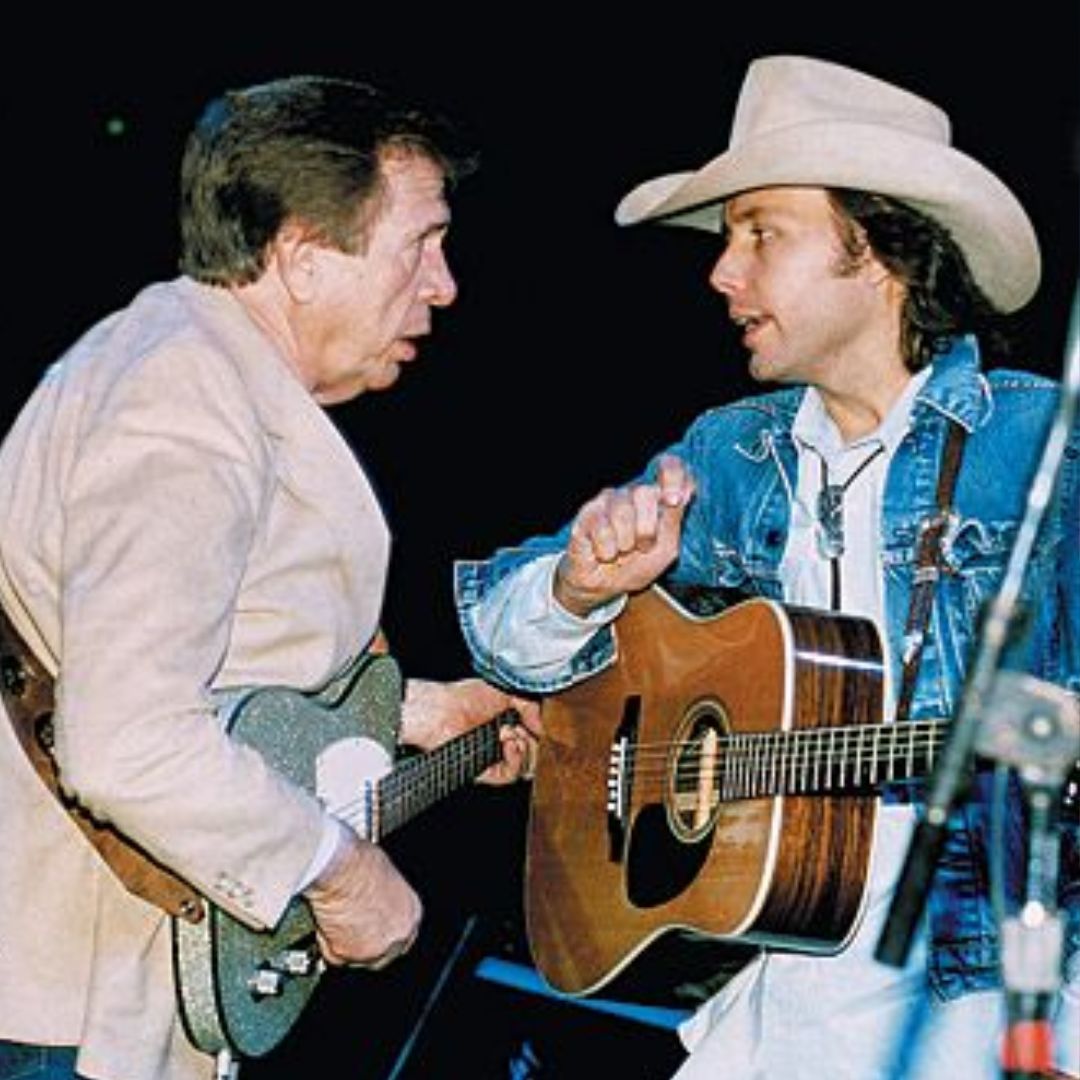
On September 23, 1987, Dwight Yoakam walked into Buck Owens’s office in Bakersfield, California, without an appointment. Dwight Yoakam had a show at the Kern County Fair that evening and wanted Buck Owens to come along—not simply to watch, but to sing.
Buck Owens had stepped away from regular live performances years earlier. Business interests occupied much of Buck Owens’s attention, while the records that had helped define the Bakersfield sound belonged to an earlier chapter of country music history.
For Dwight Yoakam, those records remained essential listening. The invitation offered a chance to share a stage with one of Dwight Yoakam’s musical heroes.
A welcome at the county fair
Buck Owens accepted. That evening, the two singers appeared together at the Kern County Fair, where the audience responded enthusiastically.
The encounter helped open a new period of attention for Buck Owens’s music. A younger performer was publicly celebrating an influence, and the audience had an opportunity to hear that influence in person.
The relationship continued beyond the fair. In 1988, Dwight Yoakam and Buck Owens recorded “Streets of Bakersfield,” a song with a history that reached back well before the unexpected office visit.
A song waiting for another chance
Written by Homer Joy, “Streets of Bakersfield” had already been recorded by Buck Owens in the early 1970s. That version had not become a major hit. Years later, the composition would find a different setting as a duet.
The song follows an outsider looking for a better life and asking for a chance to be understood. Its narrator resists the judgment of people who know little about the person standing in front of them.
That theme mattered to Dwight Yoakam. In the PBS documentary Country Music, Dwight Yoakam described the song’s connection to displaced people and outsiders across different places and cultures. The title names a particular city, but the feeling reaches beyond Bakersfield.
For the duet, the song also brought two generations into the same recording. Buck Owens returned to material from an earlier period, while Dwight Yoakam approached the composition with an appreciation for both its musical roots and its broader meaning.
The accordion that added another part of California
Working with producer Pete Anderson, Dwight Yoakam brought Flaco Jiménez into the recording to play accordion. The instrument became one of the performance’s most recognizable sounds.
Dwight Yoakam explained in Country Music that the accordion represented the Tex-Mex and California border culture that also belonged within the song’s world. The arrangement acknowledged another part of the region’s musical life and the people who had worked in the fields around Bakersfield.
Listen to the record with that detail in mind. Alongside the voices of Dwight Yoakam and Buck Owens, Flaco Jiménez’s playing gives the performance a lively, unmistakable character.
A return to the top
In 1988, “Streets of Bakersfield” reached No. 1 on Billboard’s country chart. For Buck Owens, the duet marked a first chart-topper in 16 years.
The success gave an older recording another life and brought renewed attention to Buck Owens as a recording artist. The partnership also became a close friendship. PBS’s Country Music recalled Buck Owens saying that Dwight Yoakam should have been one of Buck Owens’s sons.
When “Streets of Bakersfield” returned to the radio, listeners heard that friendship taking musical form: a younger singer beside an admired predecessor, sharing a song that had finally found its moment.