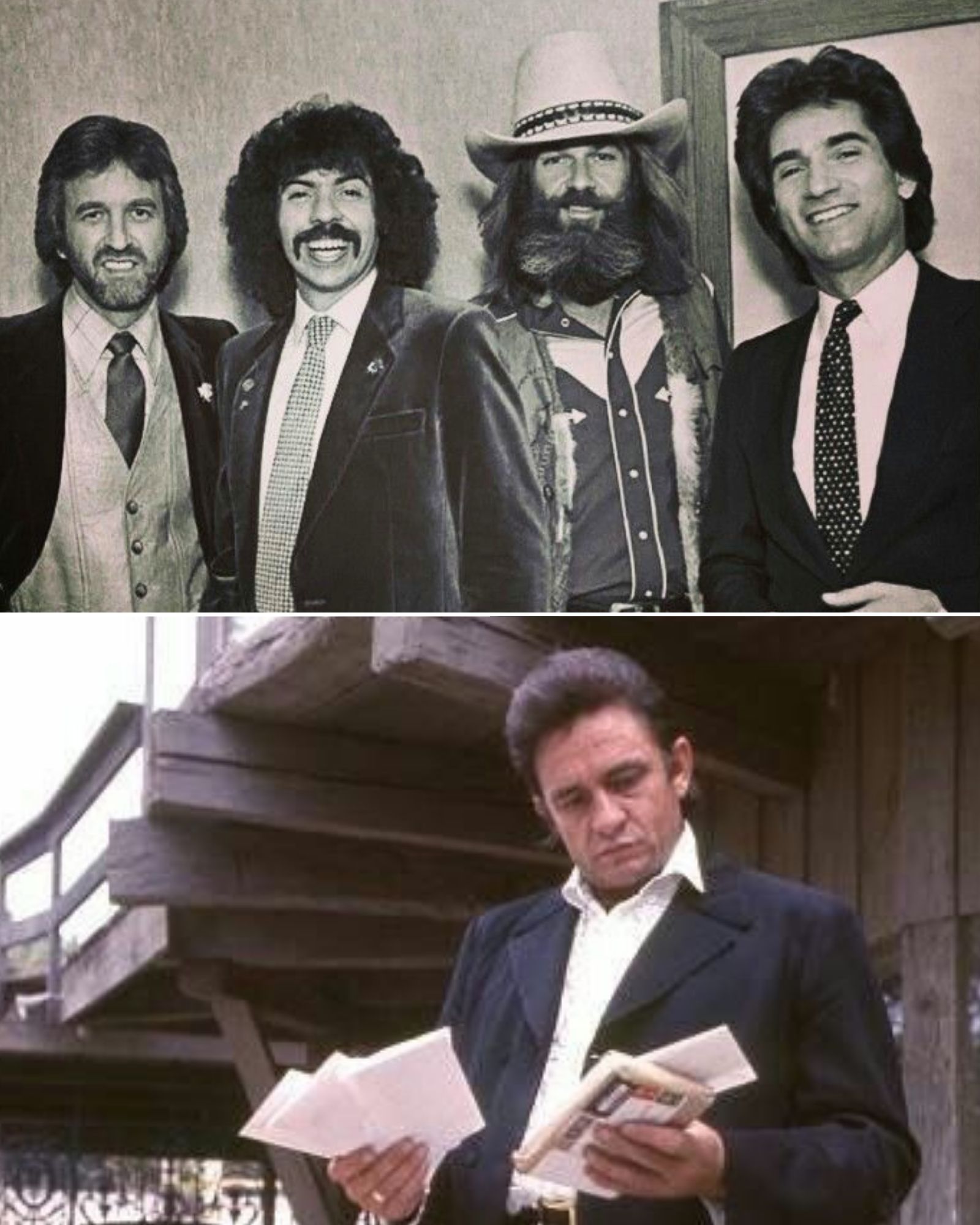
Before “Elvira,” before the Country Music Hall of Fame, before the gold records and sold-out arenas, the Oak Ridge Boys were four men trying to keep a group alive. And one of the people who refused to let them give up was Johnny Cash.
Joe Bonsall, the group’s longtime tenor, told the story for years. In the early 1970s, when the Oaks were struggling, Cash booked them on his show in Las Vegas and paid them far more than the gig was worth. As Bonsall put it in one interview, Cash did it to keep them afloat.
“He paid us more than we were worth just to keep our heads above water.” (Joe Bonsall)
The money helped. What Cash said to them helped more.
Caught Between Two Worlds
The Oak Ridge Boys had deep roots in gospel music, going all the way back to the 1940s. By the early 1970s, the lineup that fans would come to love was falling into place. Duane Allen sang lead and William Lee Golden sang baritone. Richard Sterban joined on bass in 1972, leaving a job singing backup for Elvis Presley to do it. Joe Bonsall came aboard as tenor in 1973.
Their sound was something new, and that was part of the problem. According to the group’s own history, their gospel music carried a pop edge that unsettled the purists. Country music, meanwhile, had not opened its doors to them yet. Bonsall later called the mid-1970s “the grey years,” a stretch of lean times on the road.
The Man in Black Steps In
Johnny Cash had noticed them early. In 1972, he brought the Oaks in to sing harmony on his single “Praise the Lord and Pass the Soup,” recorded with the Carter Family. It was the first time the group appeared on the country charts.
He did more than lend them a spot on a record. According to the Country Music Hall of Fame, Cash helped them sign with Columbia Records in 1973, and he featured them on his tours.
Then came Las Vegas. Cash put the Oak Ridge Boys on his show and paid them generously, well beyond what a struggling quartet could expect.
“There’s Magic Here”
But the moment the Oaks remembered most was not about money at all. Cash told them there was magic in the four of them, and he asked them to stay together.
“Don’t break up.” (Johnny Cash, as recalled by Joe Bonsall)
In another interview, Bonsall recalled Cash putting it even more simply.
“There’s magic here, guys. There’s magic here.” (Johnny Cash, as recalled by Joe Bonsall)
Bonsall never painted the group as being on the edge of collapse. Looking back, he said he did not think they ever really doubted they would be okay. They simply stuck it out. But he was clear about what Cash’s support meant.
“His belief in us was the most important thing.” (Joe Bonsall)
What Happened Next
The breakthrough did not come overnight. In 1975, the group signed with manager Jim Halsey, who pushed them to commit fully to country music and convinced them they were one hit away from stardom. After moving to ABC/Dot Records, they proved him right. “Y’all Come Back Saloon” reached No. 3 on the country chart in 1977 and launched them as a country act.
Four years later came “Elvira.” The 1981 single went to No. 1 on the country chart, climbed to No. 5 on the pop chart and won a Grammy. The quartet that once seemed caught between gospel and country now ruled the country chart and crossed over to pop radio.
In 2015, the Oak Ridge Boys were inducted into the Country Music Hall of Fame.
Cash stayed close to them over the years. The group has called him one of their earliest supporters and a longtime friend, and when later critics compared the Oaks’ late-career records to Cash’s celebrated work with producer Rick Rubin, the group welcomed the comparison.
The Voices He Believed In
Joe Bonsall, the man who kept telling this story, died on July 9, 2024, at 76, from ALS. Richard Sterban stepped away from the road in 2025 to undergo cancer treatment. Duane Allen and William Lee Golden have kept singing, with new voices filling in beside them.
More than fifty years after a Las Vegas paycheck and a few words from the Man in Black, the Oak Ridge Boys are still out there. It turns out Johnny Cash heard something real.
Do you remember the first time you heard the Oak Ridge Boys? We would love to hear your memories.