Scroll to the end of the article to hear the song.
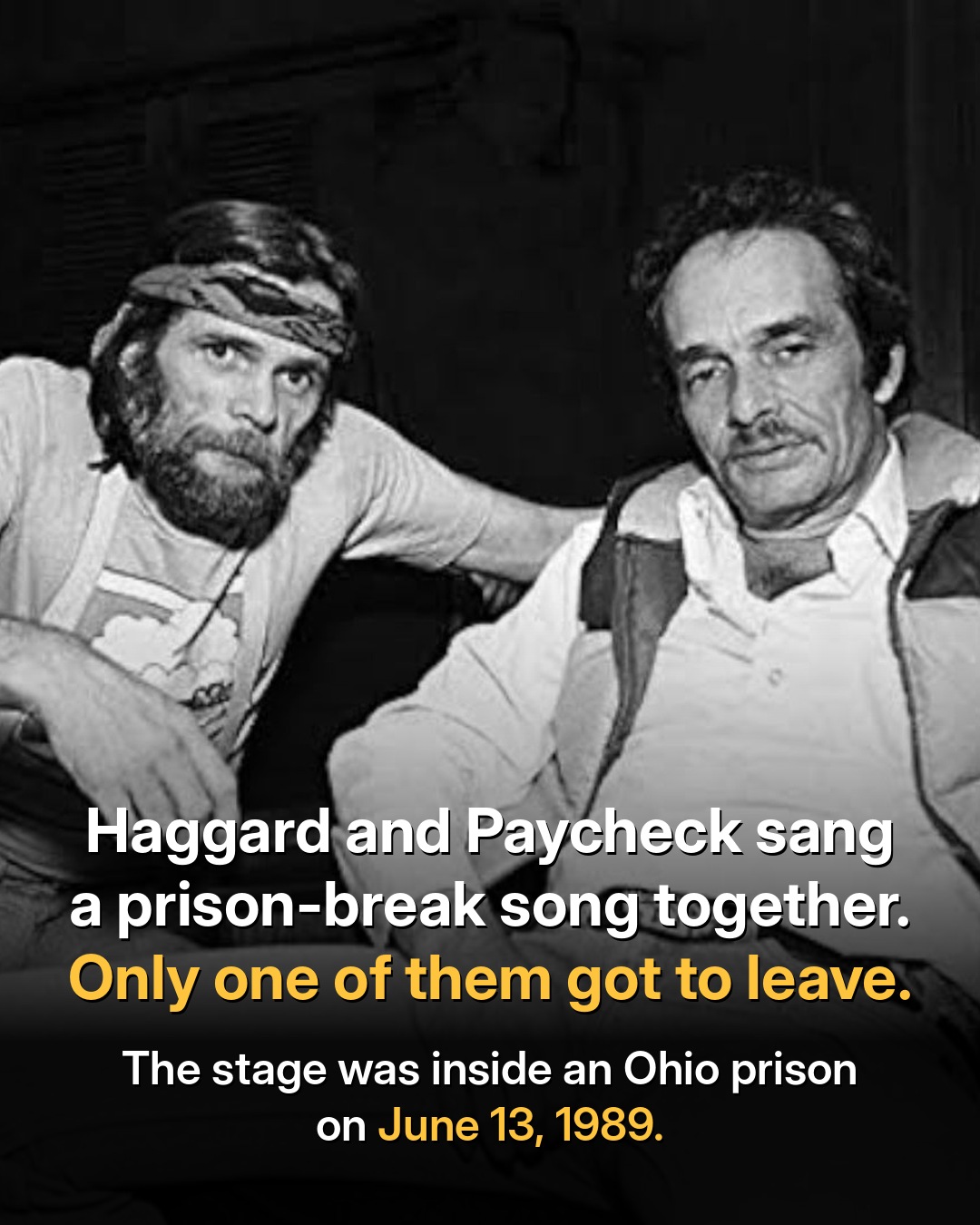
On June 13, 1989, Merle Haggard stood on a stage inside the Chillicothe Correctional Institute in Ohio and sang “I’ll Break Out Again Tonight” with Johnny Paycheck. The song, written by Whitey Shafer and A.L. “Doodle” Owens and recorded by Haggard in the 1970s, tells of a prisoner whose mind carries him home to his family every night, even though his body never leaves the cell. That afternoon, one of the two men singing it was an inmate of that very prison.
Paycheck had reported to Chillicothe earlier that year to serve a sentence of seven to nine and a half years for shooting a man in a Hillsboro, Ohio, bar in December 1985. Haggard had served his own time decades earlier, at San Quentin in California. When the concert was over, a private jet was waiting to take Haggard to his next show. Paycheck went back to being a prisoner.
It Was Paycheck Who Asked for Merle
The idea came from Billy Don Burns, the songwriter who was managing Paycheck at the time. In an account he gave years later to the country music blog Take Country Back, Burns said he was trying to lift the mood as Paycheck faced prison, so he suggested coming inside to record a live album with the inmates as the audience. Paycheck liked it and had one condition of his own.
“Yeah, if we do it call Merle Haggard. He will help.” — Johnny Paycheck, as remembered by Billy Don Burns
Getting permission was not easy. Burns said the warden, Arthur Tate, turned him down at first, and it took about fifteen return visits before the answer changed. Burns did not have Haggard’s phone number, so he went through Biff Adams, Haggard’s longtime drummer. According to Burns, Haggard called back the same day and agreed, on the condition that a Lear jet fly him from a show in Kansas City to the prison and then on to Dallas. Burns put the cost of the jet at more than $10,000.
A Recording Studio Behind the Walls
Burns described a full-scale production. A tractor-trailer mobile studio rolled in with two 24-track tape machines, four Beta video cameras, a video director and a sound crew from Nashville, about 52 people in all. Haggard brought three of his musicians, including Biff Adams on drums. When the budget came up roughly $75,000 short, songwriter Hank Cochran covered it and came on board to finance the project.
There were two concerts that day, so the crew could be sure they captured enough. The Associated Press reported that the inmates roared their approval for their fellow prisoner as Paycheck opened with a song about jail life and hard times. One inmate told the AP that in his five years there, nothing that great had ever happened at the prison.
What They Sang
Paycheck worked through the songs his audience knew, including “Take This Job and Shove It,” along with “Jailhouse Rock,” two songs written by a fellow inmate named Elmo Lincoln, and a Burns song called “Chillicothe.” Burns remembered that the crowd roared so loudly during “Chillicothe” that it drowned out the band.
Burns believed Haggard’s “Sing Me Back Home” that day was the best version of the song he ever recorded, and he singled out Haggard’s guitar playing as especially moving. Haggard also introduced a new song written for the prison show. Burns remembered its title as “I’m Learning From Inside These Walls,” while later retellings call it “Inside These Walls.” No other recording of it is known to exist.
Then came the duet. Side by side, the free man and the prisoner sang about a man who can’t be held by walls and bars because he goes home in his mind every night. Burns described Paycheck’s standing with the other prisoners simply: he was a superstar, but he had something in common with them.
A Lockdown Between Sets
According to Burns, the day nearly came apart between Haggard’s and Paycheck’s sets. Two inmates tried to escape. The prison went into lockdown, and everyone, performers and crew included, had to stay put for more than an hour until the two men were found on the roof of a building.
The Album That Never Came Out
The crew returned to Nashville with roughly fifteen rolls of audio tape and video of both shows. Burns kept working on rough mixes and even added Tanya Tucker’s vocals to “Jailhouse Rock.” Then Hank Cochran, who had financed the project, shelved it. The reason was never made public, and the album, planned under the title Inside the Walls, was never officially released.
The master tapes may not exist anymore. Aaron Rodgers, a producer and friend of Burns, has said the recordings ended up with “Cowboy” Jack Clement and were lost when Clement’s house burned. Some of the video survived, and clips from the concert have surfaced online over the years.
Paycheck served about 22 months. Ohio Governor Richard Celeste commuted his sentence, and he walked out of Chillicothe on January 10, 1991. He joined the Grand Ole Opry in 1997 and died in 2003 at the age of 64. Haggard died in 2016. Neither man lived to hear the album they made that day come out. Burns, who put it all together, has called it one of the greatest events ever caught on tape.