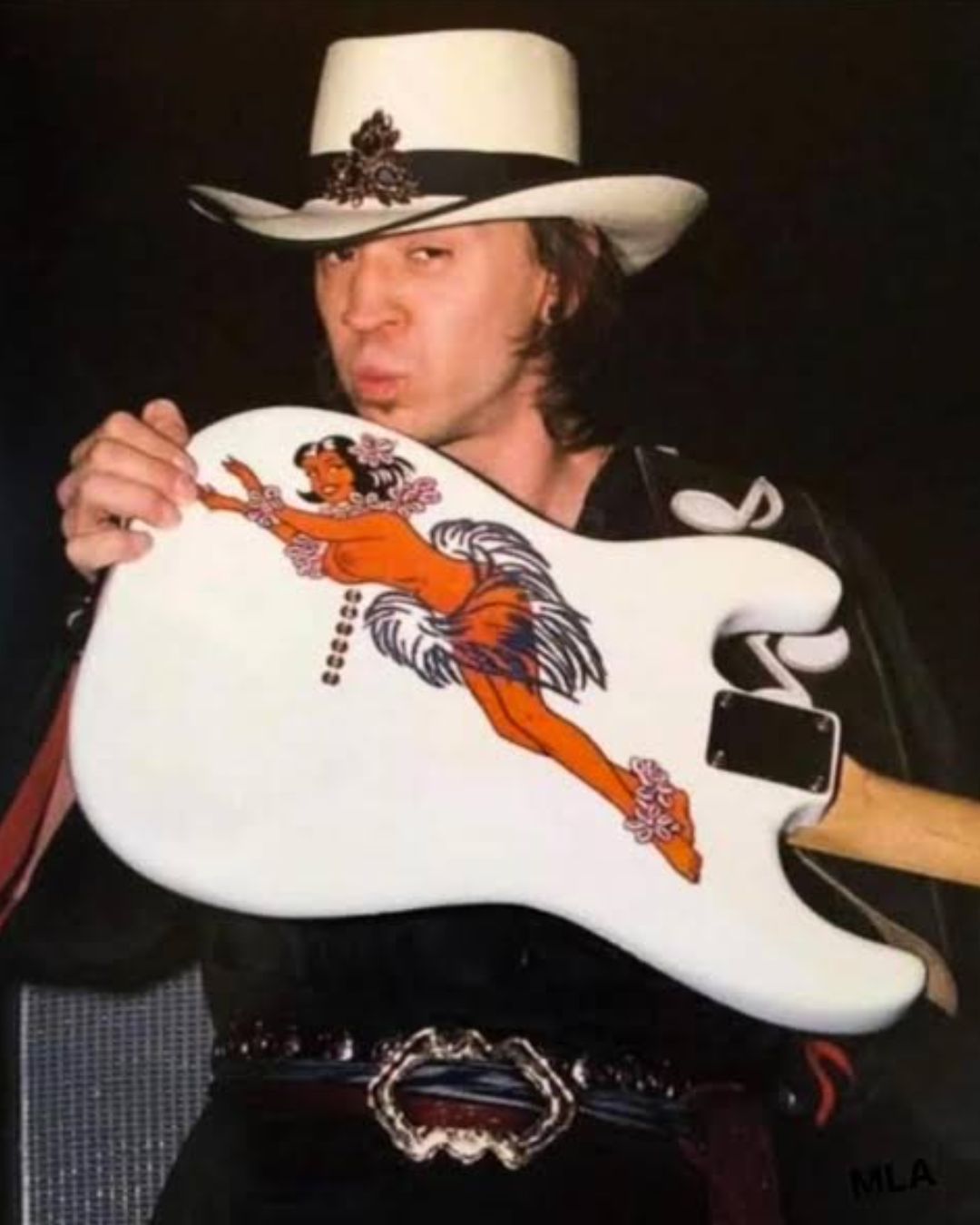
Stevie Ray Vaughan wrote “Life Without You” for Charley Wirz, the Dallas guitar shop owner who had looked after his instruments for years. When Stevie recorded it in 1985, he did it with the white guitar Charley had built for him and that Stevie had named after him. Charley had died just weeks before the sessions began.
The man behind the counter
Charley Wirz opened Charley’s Guitar Shop in Dallas in 1976. Before that he had worked as a schoolteacher and a bartender, and he wanted the shop to be a place where musicians, especially traveling ones, could come in and simply hang around. He also started a show just for vintage guitars at a time when many people treated old instruments as junk.
Stevie Ray Vaughan became one of his regulars. Charley fixed most of Stevie’s guitars when they needed it, and the shop’s repairman, René Martinez, later became Stevie’s guitar tech on the road.
In 1983 or early 1984, Charley assembled a white Strat-style guitar for Stevie, mostly from spare parts, with an ebony neck and three Danelectro “lipstick” pickups. Musician Mark Pollock, who saw it being built, later called it a Frankenstein or parts guitar. The neckplate was engraved with a promise: “More in ’84.” Stevie named it Charley, and it became one of his main guitars for the rest of his career.
February 1985
René Martinez remembered the phone call at the shop. Charley had died suddenly while visiting the NAMM musical instrument trade show in Anaheim, California. Published accounts give no cause.
At Charley’s funeral, Stevie and his older brother, Jimmie Vaughan, played “Amazing Grace” on electric guitars. Back at the shop, Charley’s widow, Carol, wasn’t sure she would keep the business going. Martinez noticed that Stevie started dropping by more often, and he wondered if Stevie was missing Charley and wanted to stay close to the place.
The song he was afraid to sing
In March 1985, Stevie Ray Vaughan and Double Trouble went into Dallas Sound Lab to begin their third album, Soul to Soul. Stevie brought in “Life Without You” mostly finished. It was not a blues shuffle. It was a slow soul ballad, closer to the singers he loved, like Curtis Mayfield and Donny Hathaway.
Bassist Tommy Shannon remembered how hard it was for him:
“He was so scared to sing Life Without You because it was so personal. He was afraid he wouldn’t be able to do it right.”
The band had trouble too. The song had a lot of chord changes and two different bridges, and they struggled to play the form smoothly. Shannon suggested ending on a minor chord, and Stevie moved the song to F minor. They cut back the extra walking lines, and Shannon suggested a solo that started with a slow whine, in the spirit of Jimi Hendrix’s “Bold as Love.”
Keyboardist Reese Wynans recalled the first full run-through. Up to the solo, it had felt tentative. Then, he said, “he just let go,” and the band could finally relax into it.
Those sessions were not easy ones. By Guitar World’s account, the drinking and drug use around the band were out of control, with Stevie and Tommy the heaviest users. Still, “Life Without You” made it onto the record as the closing track when Soul to Soul came out on September 30, 1985.
What the song became
On stage, Stevie Ray Vaughan used the song as a place to talk. In the early days he spoke about apartheid in South Africa during it. Then, in the fall of 1986, after years of hard living, he entered a treatment center in Georgia and got sober.
When he came back to the road, “Life Without You” became the moment in the show where he spoke straight to the crowd about drugs, alcohol and taking care of each other. Guitar World, interviewing him in 1988, described him working the room like a preacher during that song. Rolling Stone later quoted him saying the song was about “what drugs do to people.”
At the Mann Music Center in Philadelphia on June 30, 1987, a show recorded for radio, he told the audience he thanked God he was alive that day. He said people are here to help each other, and he asked them to take care of themselves and the people they love.
Stevie Ray Vaughan died in a helicopter crash on August 27, 1990, after a show at Alpine Valley in Wisconsin. He was 35 and had been sober for nearly four years. The vintage guitar show Charley Wirz started in Dallas kept going after Charley’s death. Today it is known as the Dallas International Guitar Festival.