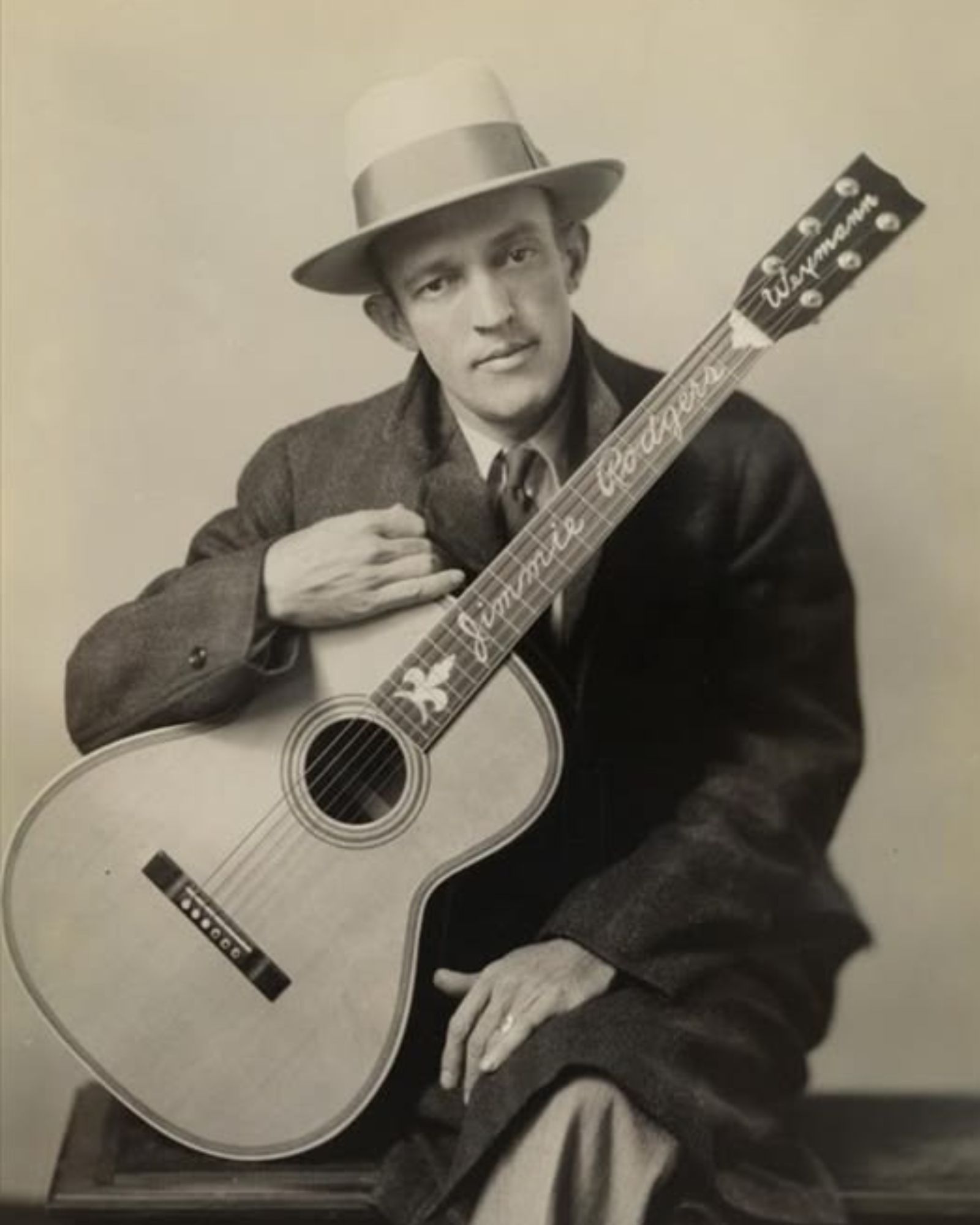
On the afternoon of May 24, 1933, Jimmie Rodgers lay down on a cot in a rehearsal hall in New York City. He rested for a few minutes. Then he got up, picked up his guitar and walked back into the studio alone to record one more song.
It was the last song he ever recorded. About 36 hours later, the Father of Country Music was dead.
Country music historian Bill Malone called those final sessions one of the most heart-rending episodes in show-business history. Here is what happened.
A dying man and a $3,000 contract
By the spring of 1933, tuberculosis had nearly finished Jimmie Rodgers. The disease had shadowed him for years, and his income had fallen along with his health. In February, he collapsed on the road and was hospitalized in Houston. Plans for a spring tour were abandoned.
Ralph Peer, the Victor Records man who had discovered him, knew time was running out. Jimmie Rodgers’ contract still paid a generous advance of $250 for every song he recorded. Twelve songs would bring $3,000 in cash. For a man who had a wife and daughter to think about, that money mattered. Along with the sale of his Texas home, it would become most of the estate he left behind.
He had already told his wife how he wanted to go. He meant to die with my shoes on, still working.
Arriving in New York
Jimmie Rodgers arrived in New York by ship on May 14, 1933, with a private nurse named Cora Bedell. Peer was worried enough to put him straight to bed at the Taft Hotel and assign someone from the office to help the nurse care for him.
After only a day or two, Jimmie Rodgers announced he was ready to work. On May 17 and 18, he recorded six songs, accompanying himself on guitar. On those first days he sounded remarkably like his old self, with the familiar flair and the famous yodel. But careful listeners can hear the strain. Shortness of breath was changing the way he phrased his lines. His lungs were badly damaged, and he was heavily sedated just to keep going.
The easy chair and the pillows
The Victor staff watching over him grew more alarmed each day. Fred Maisch, who was supervising the sessions, and Bob Gilmore, Peer’s assistant, tried to talk him into stopping. Jimmie Rodgers took one day off and insisted on going ahead with a Saturday session on May 20.
When he arrived, he was so weak that they gave him an easy chair and propped him up with pillows in front of the microphone. He recorded two songs that way. After that, Maisch and Gilmore refused to schedule another session. They persuaded him to leave the city and rest on Cape Cod.
The cot in the rehearsal hall
Three days later, Jimmie Rodgers was back in New York, pushing for one more session on Wednesday, May 24. Gilmore reluctantly agreed. To spare him as much effort as possible, Victor hired two veteran studio musicians, John Cali and Tony Colicchio, to play behind him.
A cot was set up in a rehearsal hall so he could lie down between takes. Jimmie Rodgers did not like being fussed over. When it was time to record, he refused to sit. He stood in front of the microphone as if nothing were wrong.
Shortly after noon, they recorded “Old Love Letters,” a tender ballad colored by Cali’s steel guitar. Then came “Mississippi Delta Blues,” followed by “Somewhere Down Below the Dixon Line,” a song about leaving the cold North and heading home to the South.
One more song, alone
Late in the afternoon, the two musicians were sent home. Jimmie Rodgers went back to his cot and rested for a few minutes. Then he came back into the studio by himself and recorded one final song, “Years Ago,” with nothing but his own guitar.
It was not one of his great records. But it ended his career the way it had begun. In Bristol, Tennessee, in 1927, his band had walked out before his audition, and Jimmie Rodgers recorded alone. Six years later, he finished the same way.
The last day
The next day, May 25, Jimmie Rodgers reportedly went out to Coney Island with his driver. Back in Manhattan, he chose to walk the last few blocks to the Taft Hotel. That night his condition collapsed. He suffered a massive lung hemorrhage, slipped into a coma and died on May 26, 1933, in his hotel room. He was 35 years old, far from his family and the South he loved.
Seven months later, Victor released one of the songs from that week, “Women Make a Fool Out of Me,” under a new title: “Jimmie Rodgers’ Last Blue Yodel.”
The $3,000 went home to his family. The songs went out to the rest of us.
Did you grow up hearing Jimmie Rodgers on a family record player? We’d love to hear your memories.